“The Lucky Charms guy would destroy the Burger King! He’d just teleport behind him and BOOM, it would be over!”
“No, because the kids steal the leprechaun’s lucky charms, but the Burger King always gets his man. He’ll break into your house and force you to eat at Burger King.”
Confused yet?
I certainly was.
For those of you who don’t know (as I didn’t until recently), a “bracket night” involves choosing any category – breakfast foods, power couples, TV ad characters – and pitting them against one another in a brutal, no-holds-barred fight to the death. Only one can be crowned victor and the competition is fierce. If you’ve never seen adult men argue about the supremacy of rocking chairs over bar stools, I highly recommend it.
The thing is, I’m not an argumentative person. I simply can’t muster the energy to get worked up about whether “I Love Rock’n’Roll” is a better karaoke song than “I Want it That Way” (especially since we all know “I Want it That Way” wins hands-down). I ended up leaving bracket night early because I was so stressed by the yelling and finger-pointing and accusing.
Only after I left did I realize that bracket night was a microcosm of our modern sociopolitical climate. People had strong opinions – Ron Wealsey and Hermione Granger over Ron Stoppable and Kim Possible, breakfast burritos over eggs benedict – and rather than discussing them calmly, rationally, reasonably, they shouted anyone who disagreed with them into sullen submission.
Practically all current events (impeachment, climate change, vaccines, gun control) feel divisive. The stakes are always extremely high and every debate necessitates clear winners and losers. This “us vs. them” mentality is often discussed in the media but without any hope of a solution. So, rather than lamenting all of the issues that divide us, my blog focuses on what we all have in common: biology.
You may already know that humans are 99.9% genetically identical, or that 60% of our genome (genetic material made of DNA) is the same as a banana’s. But biology is about a lot more than fun facts and memorizing the Krebs cycle. Studying natural systems not only teaches us the fascinating internal workings of all living organisms, it reveals patterns that can be extrapolated to everything we experience.
Not convinced? Here’s an example.
Cell determination is the point at which a cell is irreversibly committed to become a particular type. Even if you relocate it to another part of the body, it will still produce the same proteins and give rise to the same structures. For instance, dorsal lip cells give rise to an organism’s dorsal, or back, side. When scientists transplanted partially differentiated dorsal lip cells (cells that had begun to specialize in structure and function and had already passed the point of cell determination) to the ventral, or front, side of a salamander, the salamander grew two dorsal sides.
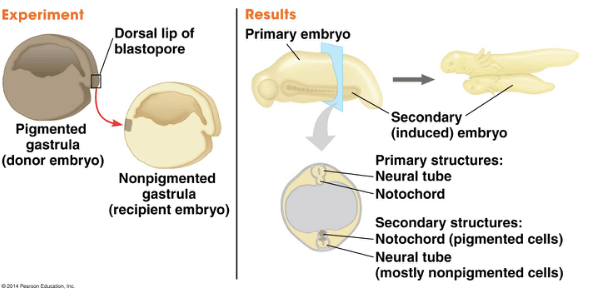
(Creepy . . . but cool.)
This phenomenon actually explains a lot about our modern sociopolitical climate. In today’s insular media environment – FOX news, twitter, facebook – people can selectively filter information and only listen to what they agree with. They have essentially undergone opinion determination: they are irreversibly committed to particular opinions and prisms through which they see the world. Take my bracket night friends, for example. They had undergone opinion determination about less important (but no less emotional) topics, and they would rather fight each other for hours than change their minds.
This also relates to something called cognitive dissonance, or “the state of having inconsistent thoughts, beliefs, or attitudes, especially as relating to behavioral decisions and attitude change.” (Thanks, google.) Essentially, cognitive dissonance is when you believe, or at least perceive, two opposing viewpoints. You can either change your behaviors to align with your beliefs, or your beliefs to align with your behaviors. Most people choose the latter. As with cell determination, they have already committed to a behavior pattern; it is too late to turn back.
Hopefully now this blog concept is starting to make a little more sense.
But still, you ask, why write about biology now? The simplest answer is that I’m taking biology now. Every new blog post will feature a concept I learned about in my introductory biology class, which I will then apply to a broader (and potentially more interesting to you) topic. I’ll show you how receptor tyrosine kinases can teach us about romance, what phosphorylation cascades reveal about Bernie Sanders’ “Tamales for Tío Bernie” campaign events, and even the biological etymology of the term “headass.” My goal is to convince you, dear reader, that biology is not just the AP exam you scored a 3 on; it’s a fascinating, eternally relevant subject that can teach us a ton about every aspect of our lives.
Oh, and in case you were curious, the Burger King won.

