Romance.
It’s probably difficult at every age, but it’s sure as hell difficult in college, where the nicest date I’ve been on was a trip to someone’s frat basement to watch him consume copious amounts of cheap beer and lose at beer pong. Repeatedly.
Is asking for a trip to an actual restaurant too much? Am I crazy for wanting someone to bring me roses on Valentine’s Day and laugh at my dumb jokes (there are many) and tell me I look beautiful when I’m wearing my high school frisbee team sweatpants and my favorite worn grey sweatshirt and I haven’t slept in days? Where is the Ron Stoppable to my Kim Possible, the Harry to my Megan, the Chuck to my Sarah? (If you didn’t get that last reference, I highly recommend checking out the TV show Chuck, although be warned that you will inevitably fall in love with Zachary Levi and then spend several weeks mourning the fact that he’s almost forty years old.) I just want someone to look at me the way Barack looks at Michelle.

Maybe you, dear reader, have already found such a person. In which case, mazel tov. And I hate you. But only a little. Or maybe you’re still searching for someone who thinks you light up their world and who truly believes all your weird quirks are charming instead of just . . . you know . . . weird. In which case, best of luck. I’m right there with you. But whatever your relationship status, if you’re anything like me, you’ve asked for relationship advice from friends, family, and most of all, the internet.
Hopefully, you’ve never had to ask anything like this:

Or this:
(If you want to see more, click here.)
But statistically speaking, you’ve probably googled something like this:
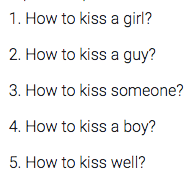
Or this:
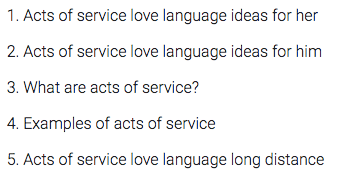
A 2019 survey of the most-googled phrases relating to romance found that these were some of the most common questions. It makes sense: first, we want to know how to win over our object of interest. Then, we want to know how to keep them. (I googled “how to kiss a guy” before my first kiss and was directed to a video depicting how to put a condom on a banana. Scarring.)
We – myself included – seek romantic guidance from a myriad of sources, but rarely (if ever) do we turn to our own bodies for the answer. And that’s a mistake.
Ah, you think. This is a post about being in touch with yourself, aware of your body, mindfulness, blah blah blah. Nope. I hate mindfulness, mostly because I’m physically incapable of sitting still and just existing for more than two seconds. Is mindfulness probably good for you? Yes. Am I going to lecture you about it? Definitely not.

(I tried meditating a few times and they all went like this.)
So if I’m not going to lecture you about inner peace, what is this post about? Three words: receptor tyrosine kinases.
Have I lost you already?
Still there?
Good.
I know the topic might sound a bit daunting, but receptor tyrosine kinases (RTKs) are actually a fundamental component of our bodies’ functioning and can teach us a lot about romance. Skeptical? Allow me to explain.
RTKs are enzymes that transfer phosphate groups from ATP (the main source of energy in our bodies) to tyrosine residues, or parts of longer amino acid chains. But which tyrosine residues?
I’m so glad you asked.
RTKs actually work in pairs (aww). When two receptors bind ligands, or a signaling molecules, they dimerize (shown below). That’s a scientific way of saying the two receptors join together and become one.
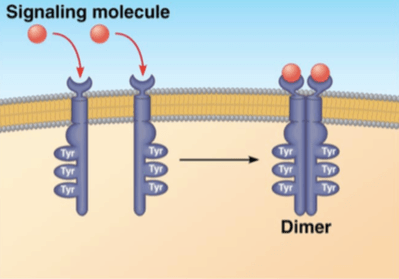
Dimerization activates the tyrosine kinase parts of each receptor – the parts that transfer phosphate onto tyrosine residues. As it turns out, the tyrosine residues they phosphorylate are on their partner monomer (the receptor to which they are bound).
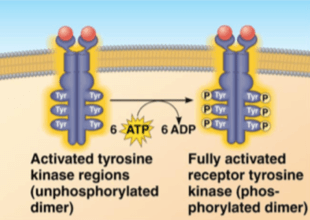
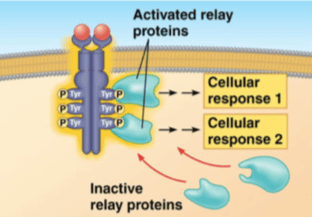
Phosphorylation activates the RTK dimer, which means that the RTK can bind to different relay proteins in the cell. Those proteins bind specific phosphorylated tyrosines and can then activate different pathways in the cell that transcribe genes, activate or inactivate other proteins, and so on. Basically, once the RTK monomers have activated each other, they can cause a cascade of other changes in the cell – all because they initially joined together.
Okay, you think. What does that have to do with romance?
Allow me to shed some light on the subject.
(Bonus points if you got the “Meet the Robinsons” reference.)
Think of the ligands that bind RTKs as whatever might initially make you and your partner attracted to one another: intelligence, humor, pure animal magnetism. You both receive these impulses, so you dimerize – you bind yourselves together. In other words, you’re dating or hooking up or otherwise expressing your mutual attraction. So, you’ve figured out how to get the person. But how do you keep them?
Let’s ask RTKs.
RTKs phosphorylate each other, which activates particular parts. Humans obviously don’t stick different chemicals onto one another to express affection (or at least, they shouldn’t). But, they do use love languages – words of affirmation, quality time, acts of service, and so on. Phosphorylation is essentially an act of service. Both RTKs activate the parts of one another that they know will be most beneficial to the cell, and which are also parts that an individual monomer couldn’t activate on its own. In the same way, people in good relationships support one another by performing acts of service that enhance their partner’s quality of life – whether it’s buying flowers, cooking dinner, or sharing a few words of affirmation. (I’m still taking applications for someone to tell me how amazing I look when I know for a fact that I look like a hot mess.)
I fully admit that this metaphor is a little – okay, a lot – cheesy. But it’s also pretty accurate. And just like with RTKs, when humans are kind to our partners, we can start a ripple effect that changes the lives of many people they encounter, just like the RTKs activate relay proteins.
Okay, that was super cheesy.
But not not true.
So what, you ask again? What does this do? What does this change?
Frankly, not much.
It won’t radically alter your sex life or get you hundreds of new matches on tinder. But hopefully, it’s given you a little insight into romance – both interpersonal and biological. So, next time you’re tempted to google something about relationships, stop for a second and think about what your body has already taught you.
And if that doesn’t work, google the Obamas.
 Biology and Me