When I was a kid, I hated the phrase “a few bad apples spoil the barrel.”
I was full of righteous indignation on behalf of the other apples. It wasn’t their fault that they were shacked up with bruised, browning, spoiled apples. They didn’t do anything wrong! Why should they be spoiled, too, just because of their proximity to the “bad” apples? (Young me was quite the SJW.)
It wasn’t until this year that I realized that saying isn’t always derogatory. It’s also not just a metaphor.
It’s literal.
A few bad apples literally spoil the barrel.
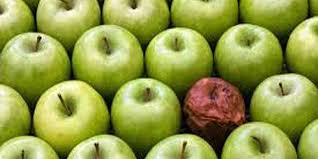
This phenomenon is due to a gas called ethylene that acts as a plant hormone – a signaling molecule that regulates plants’ physiology and behavior. I know that sounds complicated, but don’t panic (like I did while studying for the exam).
Ethylene serves several functions in plants and several factors can stimulate plants to produce it, but we’re going to focus on its role in ripening. Initially, fruits are hard, tart, and an unappealing color, which dissuades predators from chowing down on them and destroying the seeds inside. But once the seeds have fully matured, the fruit starts producing ethylene to trigger its ripening. This makes the fruit more appealing to hungry animals, who will hopefully eat it and thereby disperse the seeds (so the plant’s offspring can grow).
How does ripening work, you ask? I’d be delighted to tell you.
Ethylene activates one membrane receptor (ETR1) that’s usually inactive and inactivates another membrane receptor (CTR1) that’s usually active. This triggers a series of steps within cells that results in different genes being expressed and allows the fruit to ripen . . . and eventually spoil.
But how does that affect neighboring fruits – specifically, the other apples in the barrel?
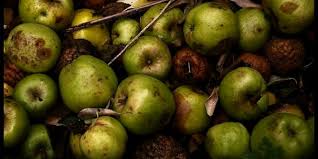
Because ethylene is a gas, it diffuses (the scientific way of saying “travels”) through the air and reaches all the other nearby fruits. This stimulates those fruits to begin creating their own ethylene – a positive feedback loop in which the product of the reactions (ethylene) leads to an increase in the reaction (so the neighboring fruits make even more ethylene). The ethylene that those fruits produce then travels to other nearby fruits and stimulates their ethylene production, and so on and so forth, until each fruit is releasing ethylene.
The result? A few bad apples spoil the barrel.
Okay, you think. I guess that would be useful if I were a farmer. But I’m not a farmer, so what does it have to do with me?
A lot, actually.
I noted at the beginning of this post that the saying “a few bad apples spoil the barrel” is often used as a metaphor. Now that you understand what it means in a literal sense, let’s explore how it can be applied to one of the most polarizing modern political topics: police brutality.
Before we get too mired in this controversial subject, I want to include a caveat: the justice system, racism, and police brutality are incredibly complex issues that are impossible to fully address in a 1,000-word blog post (especially when half of said post is about plant hormones). This is just one piece of a very important and very nuanced puzzle that represents my opinions.
With that said, let’s jump in.
According to CNN, seventy-seven U.S. police officers have been charged with murder or manslaughter since 2005, and only twenty-six have been convicted. A 2019 Proceedings of the National Academies of Science study found that “African American men and women, American Indian/Alaska Native men and women, and Latino men face higher lifetime risk of being killed by police than do their white peers.” It also concluded that the risk is highest for black men, who currently face about a 1 in 1,000 chance of being killed by police – over twice the risk of white men. Finally, the study found that “for young men of color, police use of force is among the leading causes of death.”
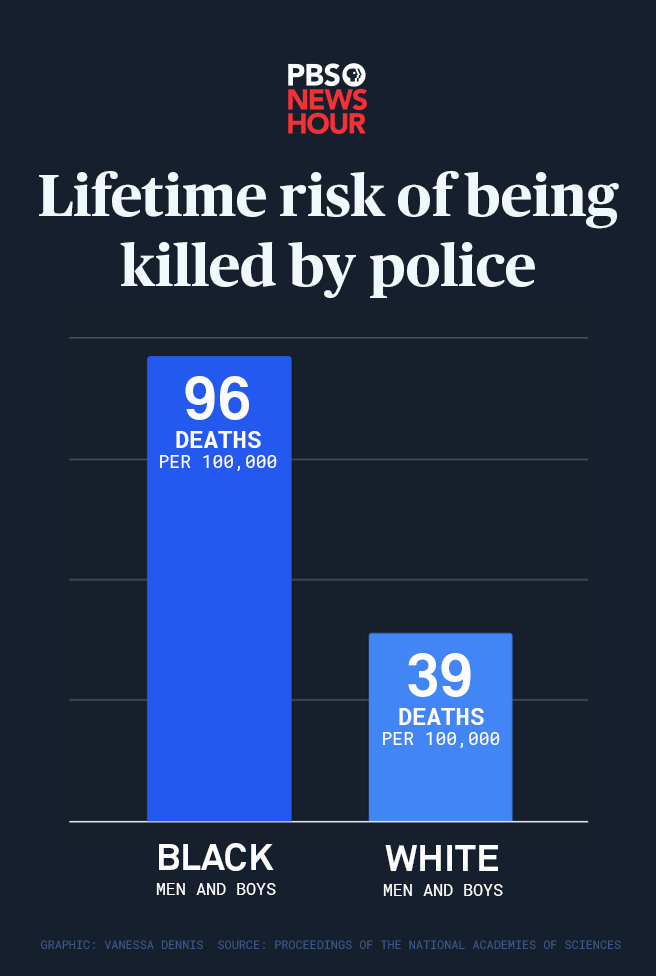
Let me repeat that: one of the leading causes of death for young men of color is the law officers who are supposed to protect them.
It’s not like this is a secret. Communities of color – and especially black communities – have had a tenuous relationship at best with police officers for decades. But this is 2020, for heaven’s sake, not 1920. No one should live in fear that an officer charged with protecting them is going to murder them in the name of “standing my ground.”
Several years ago, comedian John Oliver did a segment about the American justice system and police brutality in which he said that “the phrase isn’t ‘it’s just a few bad apples – don’t worry about it.’” He explained that the current American justice system is “set up to ignore bad apples, destroy bad apples’ records, persecute good apples for speaking up and shuffle dangerous, emotionally unstable apples around to the point that children have to attend fucking apple classes. You cannot look at our current situation and claim that anybody likes them apples.”
I couldn’t have said it better myself.
As you now know, dear reader, the bad apples – at least in biology – will always spoil the barrel. It’s inevitable. People are, of course, much more complex, but the same basic theory still applies. Just as ethylene triggers ripening (and spoiling) in nearby fruits, so our justice system encourages other “bad apple” officers to give into their worst instincts without fear of prosecution. By protecting these “bad apples” who enact police brutality and even kill innocent civilians, our criminal justice system enables them to “spoil” (aka inspire) other officers across the nation, who then mimic their indefensible actions.
Unlike in biology, however, it is not too late for us. The ripening that ethylene triggers is inexorable; police brutality is not. But we need to drastically change the incentive structures – and quickly – if we want to have any chance of stopping these bad apples from spoiling the criminal justice system barrel.
 Biology and Me